
How Generative AI Creates Text, Images, Music, and Code
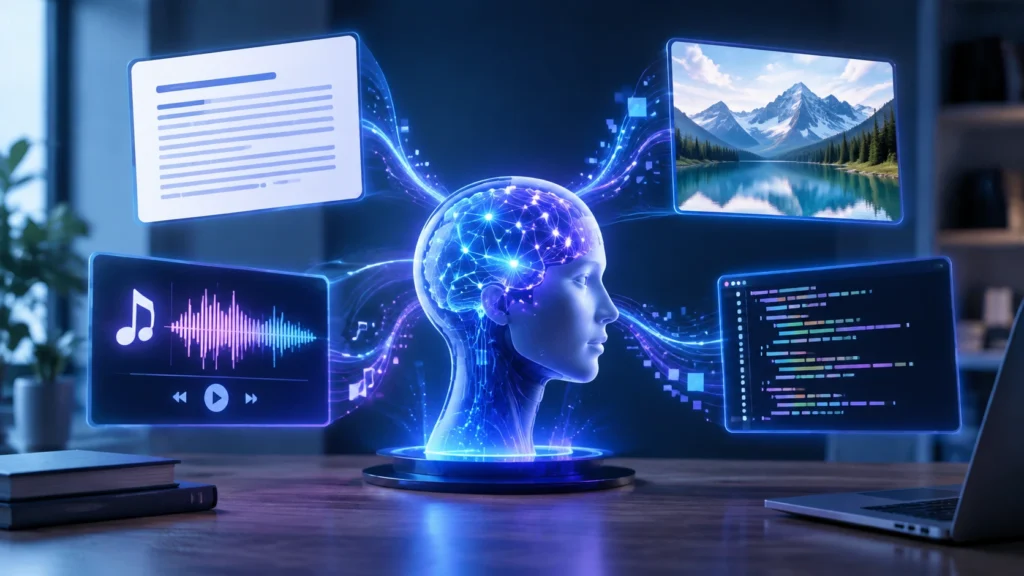
Artificial intelligence systems can now draft an email, illustrate an idea, compose a short melody, and suggest a working function. These results may look creative, but they emerge from a more mechanical process: machine learning models study large collections of examples, adjust millions of numerical settings, and learn to predict what should come next. Understanding that process makes it easier to use generative ai for content creation tools and techniques with realistic expectations.
From examples to predictions
Machine learning begins with data. A text model is trained on many passages; an image model sees large sets of pictures paired with descriptions; an audio model processes recordings; a code model examines programs and technical text. During training, the system repeatedly makes a prediction and measures how far that prediction is from the target. It then adjusts its internal parameters to reduce the error.
Those parameters, often numbering in the billions, form a compact representation of patterns in the training material. The model does not store a simple lookup table of phrases or pictures. Instead, it learns relationships: which words tend to follow others, how shapes relate to light, how musical phrases build tension, or how one block of code affects another.
When you enter a prompt, the model uses that learned structure to generate a new sequence one step at a time. In text, it may choose the next token. In image generation, it may begin with noise and gradually shape it into a coherent picture. In music, it may predict a sequence of notes or audio features. The output is newly assembled, but its possibilities are bounded by what the model learned.
How text generation works
Most modern text systems use transformer architectures. A transformer examines the relationships between words or word fragments across a passage, a capability called attention. This helps it connect a pronoun to a distant noun, preserve the terms of a question, or maintain the tone of a paragraph.
Generation is probabilistic. At each step, the model assigns probabilities to possible next tokens and selects one according to settings such as temperature. A lower setting favors likely continuations and often produces steadier prose. A higher setting allows less predictable choices, which can feel more varied but also more erratic.
Good results usually come from clear instructions. A useful prompt identifies the audience, purpose, format, constraints, and desired tone. The model can then narrow its choices. Editing, fact-checking, and adding firsthand knowledge remain essential, because fluent language can still contain errors or unsupported claims.
How image, music, and code models differ
Images
Image generators often rely on diffusion models. Training adds gradual noise to pictures and teaches the model to reverse that process. When generating an image, the system starts with random noise and takes repeated denoising steps guided by the text prompt. Composition, color, and detail emerge through this iterative process.
Diffusion makes it possible to combine concepts that may never have appeared together in training data, such as a specific art style applied to an unusual subject. It can also struggle with precise spatial instructions, consistent lettering, and exact anatomical details. Prompt wording matters, but no phrasing guarantees complete control.
Music
Music models represent sound or musical notation as sequences. Some predict notes and rhythm; others generate raw audio waveforms. They can imitate broad features such as genre, tempo, instrumentation, and structure. Producing a full arrangement with coherent harmony, lyrics, and emotional development across several minutes remains difficult. Short motifs and sketches are generally more reliable than finished compositions.
Code
Code assistants apply the same prediction process to programming languages. They use context from the current file, function names, comments, and sometimes project documentation to suggest implementations. Their strength lies in pattern matching: common algorithms, routine transformations, tests, and boilerplate are frequent patterns in training data.
Code generation is most effective when requirements are precise and the result can be tested. A plausible-looking function may contain a subtle security flaw, depend on an unavailable library, or fail on edge cases. Review, automated tests, and careful integration remain part of responsible development.
Where creativity begins and ends
Generative models are skilled at recombination. They can blend themes, restructure examples, and propose variations that a person might not have considered. Yet they do not have intentions, lived experiences, or a reliable sense of truth. Their outputs reflect patterns rather than purpose.
Several limitations appear again and again:
- Training bias: the model may reproduce imbalances or stereotypes present in its data.
- Factual uncertainty: plausible wording does not guarantee accuracy, especially for recent or niche topics.
- Context limits: long projects can exceed the information a model can attend to at once.
- Style inconsistency: repeated requests may produce noticeably different voices or visual details.
- Originality concerns: outputs can resemble existing works closely enough to raise legal or ethical questions.
- Lack of judgment: the system cannot fully weigh social meaning, safety, or professional responsibility.
These constraints do not make the tools useless. They clarify the division of labor. The model offers speed, variation, and a starting point; the person supplies goals, evaluation, accountability, and taste.
A practical workflow for creators
Start with a specific brief. Define who the work is for, what it must accomplish, and what it must avoid. Ask the model for several distinct options rather than one supposedly perfect answer. Compare the results, keep useful fragments, and combine them with your own material.
Next, verify every claim, citation, statistic, and technical instruction from an authoritative source. For visual work, check that the composition does not reproduce a protected character, logo, or recognizable artwork without permission. For music, confirm the rights attached to generated recordings. For code, run tests and inspect dependencies.
Finally, revise deliberately. Generative systems are strongest at producing volume; people are strongest at selection. A calm workflow treats the output as a draft, not a verdict. With clear prompts, careful verification, and human editorial control, these tools can accelerate ideation and production while leaving creative responsibility where it belongs.