Supervised vs Unsupervised Learning Explained With Examples
Artificial intelligence systems often learn from examples rather than following only fixed rules. The two starting points are supervised learning, where a model learns from labeled answers, and unsupervised learning, where a model searches for structure without labels. This supervised vs unsupervised learning explained with examples guide shows how each approach works and when to use it.
What Machine Learning Is Really Doing
Machine learning is a way to improve performance on a task by studying data. Instead of writing a rule for every case, you give a system patterns from which it can generalize. A model adjusts its internal parameters as it sees examples, then uses those settings to make predictions or organize new information.
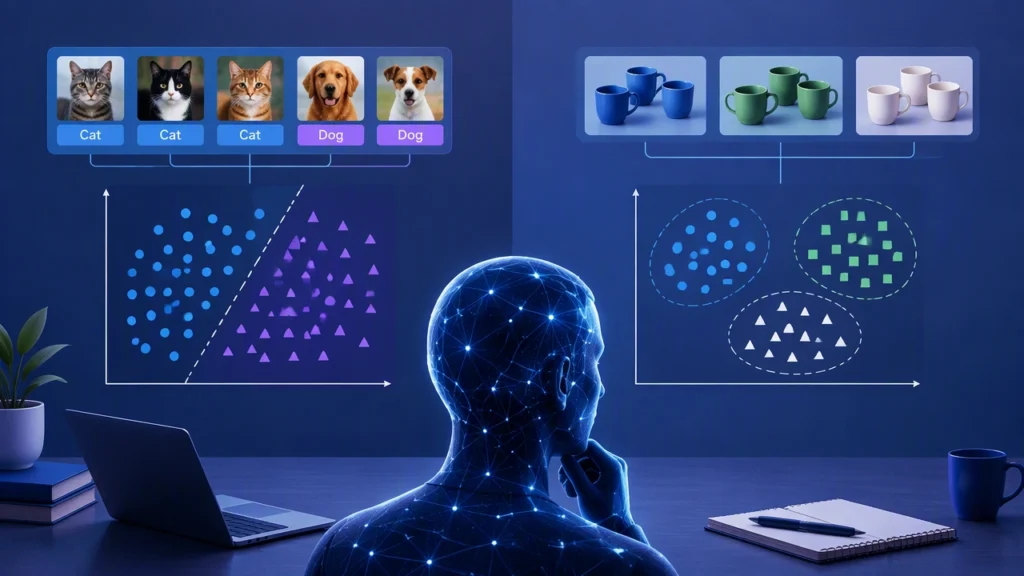
The key difference between the two main approaches is the kind of feedback available. Supervised learning uses correct outcomes during training. Unsupervised learning receives only inputs and must discover useful structure on its own. Choosing between them depends on the question you are asking, the data you have, and how you will measure success.
How Supervised Learning Works
In supervised learning, each training example includes an input and a known target. The model compares its output with the target, measures the error, and updates itself to reduce that error. Repeated across many examples, this process helps the model learn a mapping from inputs to outcomes.
There are two common forms:
- Classification predicts a category, such as whether an email is spam or whether an image contains a cat.
- Regression predicts a quantity, such as a house price, energy demand, or temperature.
A practical example is fraud detection. A bank can provide historical transactions labeled as legitimate or fraudulent. A supervised model learns which combinations of amount, location, timing, and merchant type are associated with each label. When a new transaction arrives, it assigns a risk score that helps reviewers decide what to investigate.
Another example is medical image screening. If radiologists have marked scans as showing or not showing a particular condition, a model can learn from those labels and flag cases for closer review. The model does not replace a clinician; it helps prioritize attention and make expert work more consistent.
Strengths of supervised learning
- Performance can be measured directly against known answers.
- Models are well suited to clear decisions with defined categories or values.
- Results are often easier to explain when the features and labels are understood.
Limits of supervised learning
Labels are expensive. Someone must create them accurately, and errors in the labels can teach the model the wrong pattern. Supervised learning also tends to reproduce the habits of the data it was trained on, so biased or outdated examples can lead to biased or outdated predictions. Finally, it can only recognize outcomes represented in the training data; it may struggle when conditions change sharply.
How Unsupervised Learning Works
Unsupervised learning has no answer key. The system examines inputs and looks for regularities such as groups, contrasts, or compressed representations. Because there is no single correct output, evaluation relies on measures like cluster stability, separation, reconstruction quality, or usefulness for a later task.
Common forms include:
- Clustering groups similar items together.
- Dimensionality reduction simplifies many variables into fewer meaningful components.
- Association discovery finds items that frequently occur together.
A practical example is customer segmentation. A retailer can group shoppers by browsing behavior, purchase frequency, and product preferences without first assigning segments by hand. The resulting groups might reveal budget-focused buyers, occasional visitors, or loyal customers. Marketers can then tailor messages and test whether a segment responds better to one offer than another.
Another example is anomaly detection in manufacturing. Sensors on a production line generate many readings but no label for every failure. An unsupervised model can learn what normal operation looks like and highlight readings that are unusually far from that pattern. Engineers can inspect those alerts and decide which ones deserve action.
Strengths of unsupervised learning
- It works when labels are unavailable or too costly to collect.
- It can reveal hidden structure that people had not anticipated.
- It is useful for exploration, data cleanup, and finding rare cases.
Limits of unsupervised learning
Results can be ambiguous. Different settings may produce different groups, and the groups may not match business or scientific meaning. Unsupervised models can also amplify noise if the data contain errors or irrelevant variables. Because there is no fixed target, comparing methods requires careful judgment and domain knowledge.
Supervised vs Unsupervised Learning: Practical Comparison
Consider a support team that wants to route incoming tickets. If past tickets have been assigned to departments, a supervised classifier can learn from those labels and suggest the right queue for new messages. If no labels exist, clustering can organize tickets by wording and topic so the team can review the groups before creating routes.
Consider a research project on customer feedback. Supervised sentiment analysis can mark comments as positive, negative, or neutral when training examples exist. Unsupervised topic modeling can instead discover recurring themes such as delivery, pricing, or product quality, even when no one has predefined them.
The choice also depends on risk. When a wrong prediction has serious consequences, labeled data and measurable accuracy are valuable, which favors supervised learning. When the goal is to understand a new dataset, supervised labels may not exist yet, so unsupervised exploration is a sensible first step.
When to Use Each Method
Choose supervised learning when
- You have a clear target variable and enough reliable labels.
- You need to make repeatable predictions or decisions.
- You can evaluate accuracy, error, or another metric against known outcomes.
Choose unsupervised learning when
- You need to explore data before defining categories.
- Labels are missing, slow to obtain, or inconsistent.
- Your goal is segmentation, compression, anomaly discovery, or pattern finding.
A Balanced Path
Many real projects combine both approaches. Teams may start with unsupervised learning to clean data, find natural groups, and identify useful features. They then use a small labeled sample to train and evaluate a supervised model. When new predictions arrive, the results can become labels for future training, provided humans review them for quality.
The practical rule is simple: use supervised learning when you know the answer you want and can show examples of it. Use unsupervised learning when you need the data to reveal what matters first. Starting with the right question, checking data quality, and testing results against real-world outcomes will matter more than choosing a fashionable algorithm.