Transformer Architecture Explained Simply for Beginners: Self-Attention and Positional Encoding in Plain English
Artificial intelligence surrounds us, but many of its recent leaps come from one design: the transformer. If you have wondered how modern chatbots, translators, and writing assistants understand words so well, the answer starts with the transformer architecture explained simply for beginners. This article walks through the big ideas in plain language, focusing on two key ingredients: self-attention and positional encoding.
At a high level, a transformer reads a whole sentence at once and learns how each word relates to every other word. Instead of moving strictly from left to right, it lets the model weigh which tokens matter most for each position. That simple shift, from strict sequence to flexible attention, unlocked much richer language understanding.
What a transformer does with text
When a transformer sees a sentence, it first turns each word or subword into a numeric representation called an embedding. Think of an embedding as a point in a high-dimensional space where similar meanings live nearby. These embeddings become vectors that the model can move, mix, and compare. From there, the transformer stacks several layers that refine those vectors step by step, building meaning from syntax to semantics.
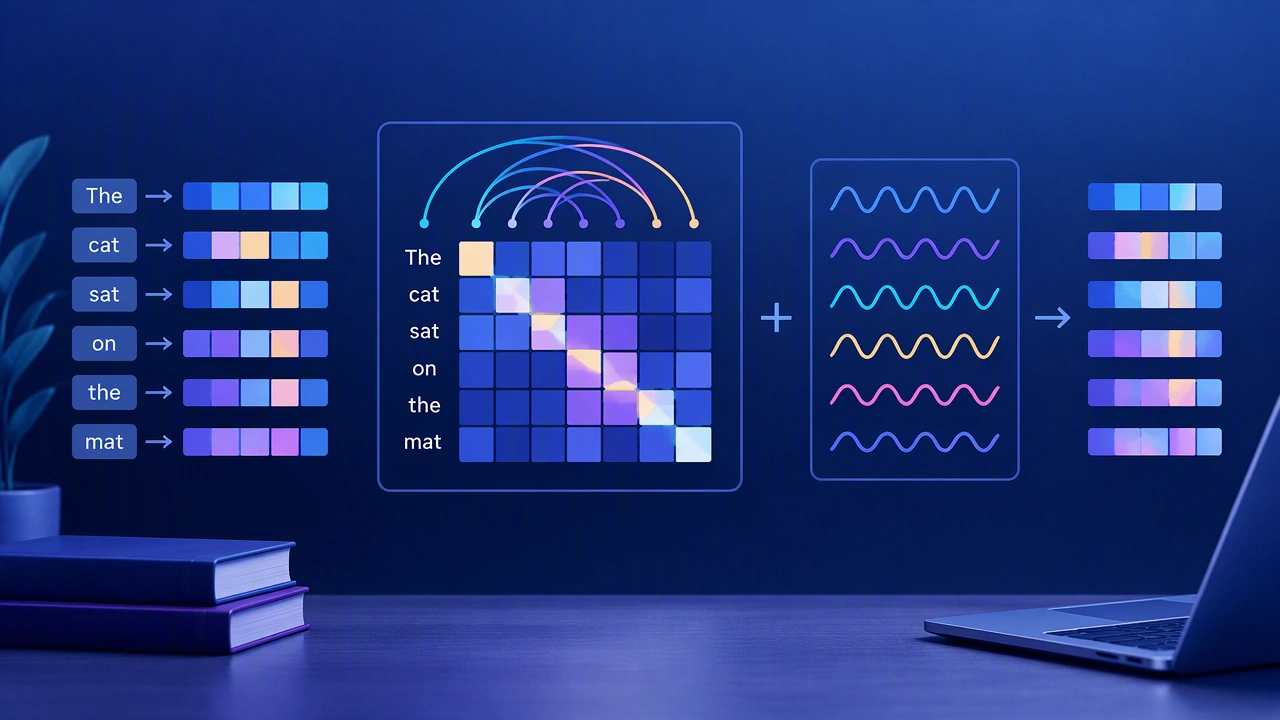
Two ideas drive the magic. First, self-attention decides how much each token should listen to every other token. Second, positional encoding tells the model where each token sits in the sequence, because attention alone does not know order. With these tools, the model can learn patterns like subject-verb agreement, long-distance references, and even subtle tone shifts.
Self-attention: letting words choose their context
Imagine you are reading the sentence: “The cat sat on the mat because it was soft.” The word “it” could refer to the cat or the mat. Self-attention helps the model decide by creating three vectors for each token: a query, a key, and a value.
- The query asks, “What am I looking for?”
- The key advertises, “Here is what I contain.”
- The value provides, “Here is the information I can share.”
For each token, the model compares its query with the keys of all tokens, including itself. These comparisons produce attention scores. After a scaling step and a softmax, the scores become weights that sum the values. The result is a new representation that blends in the most relevant context.
Why this matters: attention is content-based. The model does not rely only on nearby words; it can jump across the sentence to connect a pronoun with its noun, or a verb with its subject, even when they are far apart. That flexibility is a core reason transformers perform so well on long, complex texts.
Multi-head attention: many lenses at once
Transformers do not use a single attention operation. They run several in parallel, called attention heads. Each head learns a different pattern. One head might track syntax, another might link synonyms, and another might focus on negation or numbers. By combining these heads, the model gathers multiple kinds of context at the same time.
After the heads compute their results, a small neural network mixes their outputs. This gives the model a richer view of the sentence, like looking through several filters that each highlight a different feature.
Positional encoding: giving the model a sense of order
Attention is order-agnostic by design. If you shuffled the words, the attention scores would be the same. But word order is crucial in language. “Dog bites man” and “man bites dog” mean very different things. Positional encoding solves this by adding a signal that marks each token’s place.
Early transformers used fixed signals based on sine and cosine waves at different frequencies. Later designs learn positional embeddings directly from data. Either way, the message is the same: the model receives a hint about position, so it can distinguish first from last, nearby from distant, and beginning from end.
You can think of positional encoding as tiny tags added to each embedding. These tags let the model say, “I am token number 5” or “I am near the start,” while still letting attention decide which tokens to focus on. The result is a balance: position provides structure, and attention provides focus.
How the pieces work together in a layer
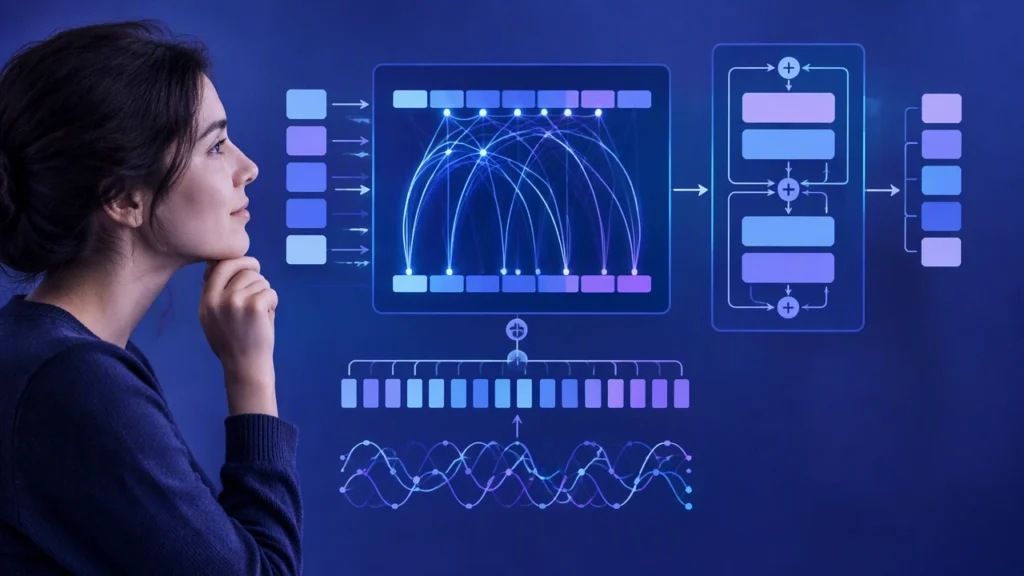
A typical transformer layer follows a repeatable pattern. First, self-attention gathers context. Then a small feed-forward network processes each token independently to transform its representation. Around both steps, residual connections and normalization help keep training stable and gradients healthy. Stacking many layers lets the model move from simple patterns to abstract ideas.
In encoder-only models, the stack builds deep understanding for tasks like classification or search. In decoder-only models, which power many modern language assistants, attention is often masked so each token can only look at earlier tokens during generation. In encoder-decoder models, the decoder attends to the encoder’s output, which is useful for translation or summarization.
Why this design scales so well
Transformers are highly parallel. During training, attention over a sequence can run on modern hardware with large batches, which makes learning faster and more stable. That scalability, paired with attention’s ability to model long-range relationships, is a major reason transformers became the backbone of modern natural language processing.
Just as important, transformers generalize. The same core architecture works for text, code, images, audio, and more, with task-specific tweaks. Self-attention learns patterns that transfer across domains, which is why fine-tuning a pretrained transformer can solve many problems with relatively little extra data.
A simple mental model for beginners
If you are new to this area, here is a compact way to picture it:
- Embeddings turn words into vectors.
- Positional encoding adds order information.
- Self-attention mixes each token with the most relevant others.
- Multi-head attention does this with several lenses at once.
- Feed-forward layers refine each token’s representation.
- Stacked layers build deeper understanding step by step.
With this structure, the model can learn grammar, facts, reasoning patterns, and style, all from data and feedback.
What to remember
The transformer’s power comes from letting each token decide, based on content, which other tokens matter, and from telling the model where those tokens sit. Self-attention provides flexible, long-range context. Positional encoding provides order. Together, they create a simple but powerful recipe that scales and generalizes. That is why the transformer architecture explained simply for beginners often starts with these two ideas: attention for meaning, and position for structure.