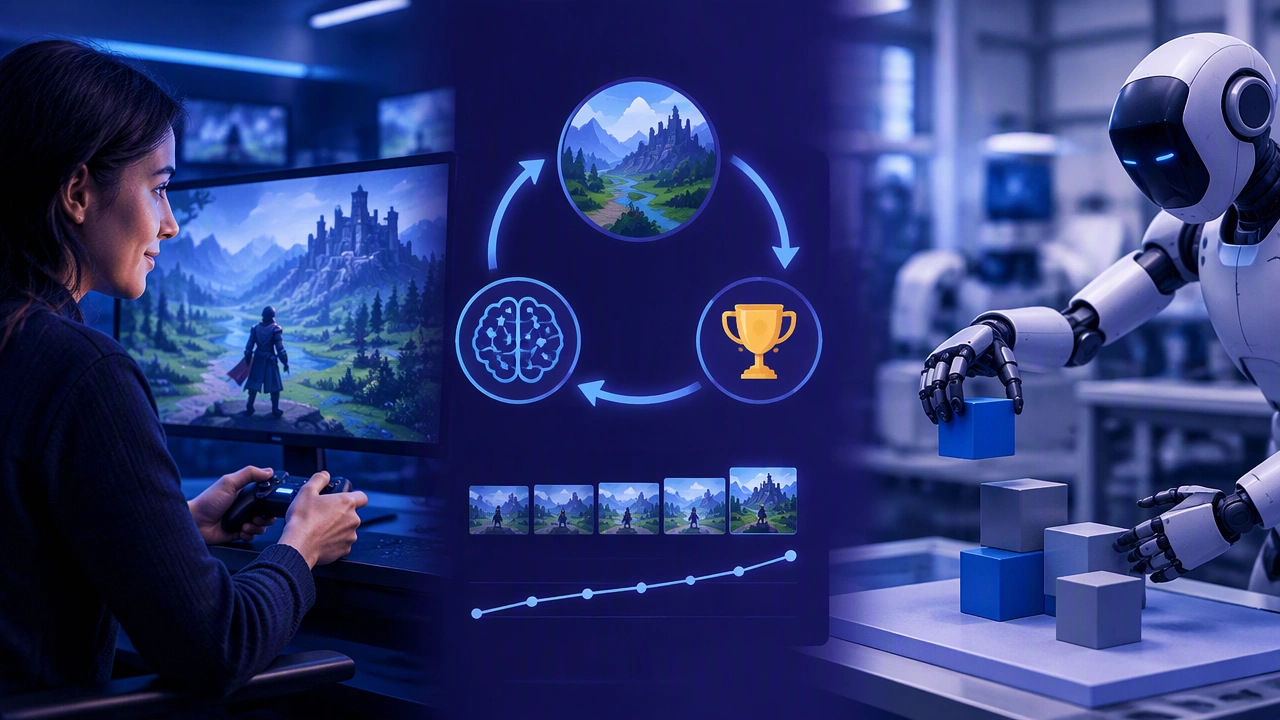
How Reinforcement Learning Trains Game Masters and Robots
Artificial intelligence often seems mysterious because we cannot watch a computer think. Reinforcement learning makes the process easier to picture. An agent learns by trying actions, observing the results, and adjusting its choices to earn more reward over time. The same basic idea can help a virtual player improve at a board game and help a physical robot learn to pick up an object without dropping it.
What reinforcement learning is
Reinforcement learning is a branch of machine learning in which a learner, called an agent, interacts with an environment and receives feedback as numerical rewards or penalties. The agent does not receive a list of correct answers for every situation. Instead, it explores, evaluates outcomes, and builds a strategy that tends to produce good results.
The environment can be a game board, a simulated world, or a room containing a robot. The agent chooses an action, the environment changes, and a new observation arrives. A reward might be positive for scoring a point or reaching a goal and negative for making an illegal move or hitting an obstacle. Over many episodes, the agent learns which actions are useful in which situations.
The reward loop
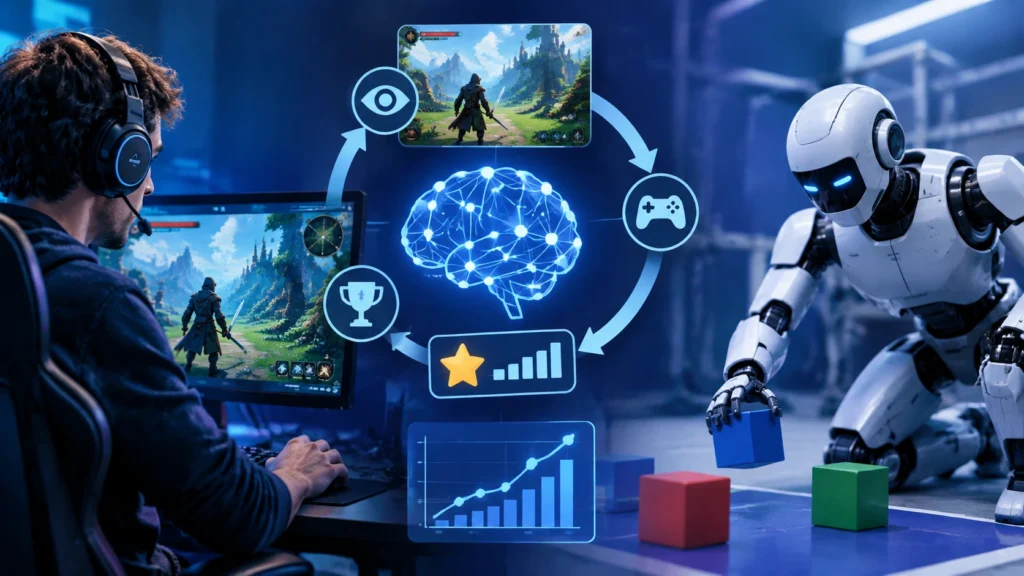
The central mechanism is a feedback loop:
- Observe: The agent reads the current state, such as the positions of pieces or the robot’s joint angles.
- Act: It selects an action from the available choices.
- Evaluate: The environment returns a reward and a new observation.
- Update: The agent adjusts its policy, which is its rule for choosing actions in future states.
Rewards can be immediate or delayed. A game agent may receive a small reward for collecting an item and a large reward for winning several moves later. A robot may receive a tiny reward for moving closer to a target and a large reward for completing a task. Because future rewards matter, the agent must balance short-term gains against long-term success.
Exploration and exploitation
Learning requires a balance between exploration and exploitation. Exploitation means choosing the action that currently looks best. Exploration means trying alternatives that might be better but are less certain. If an agent only exploits, it may get stuck in a mediocre strategy. If it only explores, it may never settle on a reliable plan.
Simple methods use an epsilon-greedy rule: most of the time the agent chooses its best-known action, and with a small probability it chooses a random action. More advanced methods estimate uncertainty or plan ahead. In either case, the goal is to collect useful experience while continuing to improve.
From trials to a policy
A policy maps observations to actions. Early in training, the policy may be random and produce many failures. As experience accumulates, the agent learns values that estimate how good a state or action is likely to be. It can then prefer actions that lead to states with higher expected returns.
Value-based methods, such as Q-learning, estimate the value of taking an action in a state. Policy-based methods directly adjust the probabilities of actions. Actor-critic methods combine both ideas: an actor chooses actions while a critic evaluates them. These approaches differ in detail, but all rely on the same principle of improving behavior through feedback.
Why games are a natural training ground
Games provide clear rules, repeatable trials, and precise scores. This makes them ideal for studying reinforcement learning applications in games and robotics. A game agent can play thousands or millions of episodes in a simulator, trying strategies that would be slow or risky in the real world.
In board games, the agent learns to value positions, anticipate opponent responses, and plan several moves ahead. In arcade-style games, it learns to connect short actions, such as moving or jumping, with long-term outcomes such as a high score. The environment supplies a clean signal: the score changes, a level is completed, or the game ends.
Games also reveal important limitations. A perfect score in a simulator may depend on assumptions that do not hold elsewhere. The agent may exploit quirks in the game engine rather than learn a useful general skill. Good design therefore includes varied levels, hidden information, or randomized conditions so that the learned policy is robust.
Teaching robots through experience
Robots face a harder learning problem. Their actions affect physical objects, sensors are noisy, and mistakes can damage equipment. Reinforcement learning still applies, but training usually begins in simulation. A simulated arm can practice grasping, balancing, or navigating without breaking parts or endangering people.
Once a policy performs reliably in simulation, engineers can transfer it to a real robot while monitoring safety. Domain randomization changes lighting, friction, mass, and camera positions during training, helping the policy adapt when reality differs from the simulator. Careful reward design is also essential. A reward for moving quickly must be balanced against penalties for collisions, excessive force, or unstable motion.
Common robotic tasks include picking and placing objects, walking over uneven ground, following a path, and coordinating multiple joints to pour liquid or open a door. In each case, the agent learns a sequence of small decisions that produces a useful overall behavior.
Challenges that remain
Reinforcement learning is powerful, but it is not automatic. Poorly chosen rewards can lead to surprising behavior. If the only goal is to collect points, an agent may find a shortcut that earns rewards without accomplishing the intended task. This is sometimes called reward hacking, and it shows why objectives must be carefully specified.
Training can also be sample-inefficient, requiring many interactions before behavior becomes stable. Real-world interactions are expensive, so researchers use simulators, demonstrations, and offline data to reduce risk. Safety, interpretability, and fairness are important when learned policies influence people or operate expensive machinery.
A practical way to understand the idea
Imagine a small robot learning to reach a charging station. At first it moves randomly and sometimes bumps into walls. Each step toward the station earns a small positive reward; collisions earn a penalty. Over many attempts, the robot learns a policy that favors open paths and efficient turns. The same loop explains a game agent that discovers a strong opening or a robot arm that learns a stable grip.
Reinforcement learning turns practice into measurable improvement. By connecting observations, actions, and rewards, agents can master games and control robots through experience rather than explicit instructions. Understanding this feedback loop is a useful foundation for following current advances in artificial intelligence and for judging where these systems are reliable, where they need supervision, and where careful testing still matters.