
How Does Natural Language Processing Work? Tokenization, Embeddings, and Attention Explained
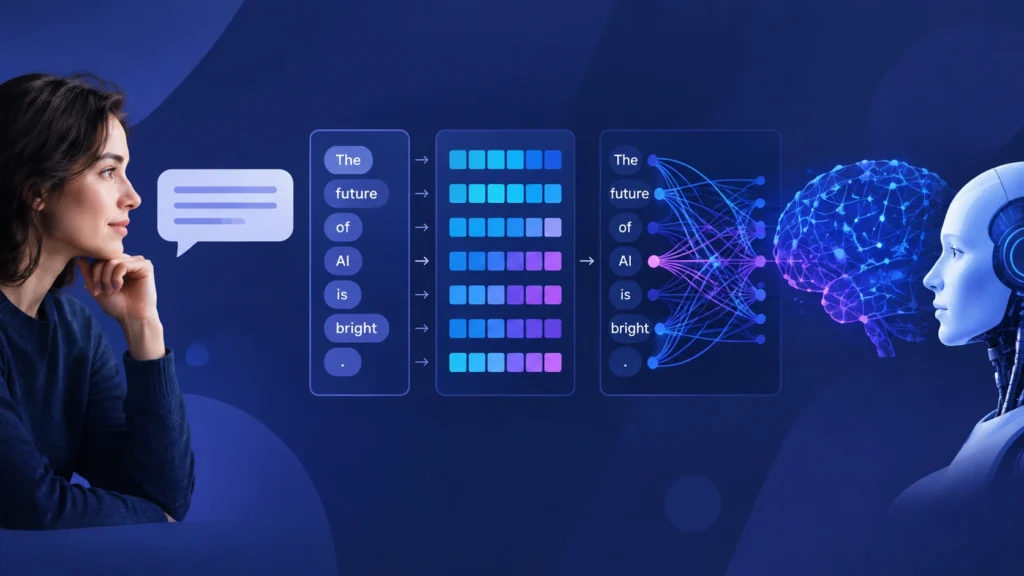
Artificial intelligence can translate a paragraph, summarize a meeting, or answer a question in plain English. Yet the machine never sees language the way a person does. It receives a sequence of symbols, converts them into numbers, and calculates which parts of that sequence matter for the task at hand. To understand how does natural language processing work step by step, it helps to follow one sentence from raw text to generated response.
Step 1: Turning text into tokens
The first step is tokenization. A model splits text into smaller units called tokens. A token may be a whole word, part of a word, punctuation, or even a space. For example, the sentence Cats sleep. might become the tokens Cats, sleep, and .. Splitting words into pieces also lets a model handle rare forms such as unbelievable by recognizing smaller meaningful parts.
Each token is mapped to an integer from a fixed vocabulary. That vocabulary is created during training and sets the boundaries of what the model can represent directly. If a word is misspelled or has never been seen, the tokenizer can often break it into familiar fragments rather than treating it as meaningless.
Tokenization is not just a formatting chore. It affects how much context the model can process, how efficiently it runs, and how well it handles names, numbers, code, and other specialized text. A sentence becomes a sequence of IDs, which is the first bridge from language to mathematics.
Step 2: Giving tokens numerical meaning
Numbers alone do not tell the model that king and queen are related. The next step is to convert each token ID into an embedding, a list of numbers that represents the token in a high-dimensional space. Similar meanings tend to land near one another, while unrelated meanings sit farther apart.
Embeddings are learned during training. The model adjusts them so that predictions become more accurate across millions of examples. Context changes the representation: the word bank in a river sentence should be positioned differently from bank in a financial sentence. Modern language models therefore create contextual embeddings rather than relying on one fixed vector per word.
Think of an embedding as coordinates in a map of concepts. The axes do not have simple human labels, but distances and directions encode useful relationships. This is how a model can compare phrases, group synonyms, and reason about similarity without an explicit dictionary of definitions.
Step 3: Deciding what matters with attention
Once tokens have embeddings, the model must understand relationships among them. This is where attention comes in. For each token, attention calculates how strongly it should listen to every other token in the sequence. The result is a set of weights that say, in effect, which words are relevant right now.
In the sentence The dog chased the ball because it was fast, resolving it requires looking back at nearby nouns and their roles. Attention lets the model compare the pronoun with candidate words and assign more weight to the one that makes the sentence coherent. The same mechanism helps with long-distance dependencies, such as matching a question to a fact several clauses away.
Attention is computed in parallel across positions. Each token produces a query, a key, and a value. Queries ask what the current token needs, keys describe what other tokens offer, and values carry the information that will be combined. Matching a query with keys produces weights, and the weighted values become the token’s updated representation. Stacking many attention layers lets the model build increasingly abstract views of grammar, intent, and topic.
Step 4: Adding structure and context
Attention alone is not enough. Models also add positional information so they know the order of tokens. Without it, dog bites man and man bites dog would look like the same collection of words. Position signals can be fixed patterns or learned vectors, and they are combined with embeddings before attention runs.
Between attention layers, neural network blocks transform each token representation, capture local patterns, and prepare the next round of comparisons. Residual connections and normalization keep training stable. After many such layers, each position holds a rich summary of the sentence and its context.
Step 5: Generating language
For understanding tasks, the model may turn its final representations into labels, scores, or answers. For generation, it predicts the next token. The final vector for the current position is mapped to probabilities over the vocabulary. The system then selects a token, appends it to the sequence, and repeats the process.
Sampling settings influence the result. A high-probability choice produces predictable text, while allowing lower-probability options adds variety. The model does not retrieve a prewritten sentence; it builds one step by step, using the growing context to guide each decision. This is why a small change in an early word can alter everything that follows.
What the process does not guarantee
A language model is a pattern learner, not a fact database. It can produce fluent text that sounds confident even when it is wrong. Its knowledge is shaped by training data, and its answers depend on the context provided in the prompt. Evaluation, human review, and reliable sources remain important when the stakes are high.
Tokenization, embeddings, attention, and generation form a pipeline rather than isolated tricks. Tokens provide the units, embeddings provide meaning, attention provides focus, and decoding provides output. Seeing the pipeline in order makes the behavior of everyday AI tools less mysterious and more useful to work with.